Thursday, June 12, 2014

Ich bin ein Berliner

I spent the past week in Berlin on business. We arrived Tuesday late afternoon and ran events through Friday night. One of my main tasks while in Paris was working on Friday's final event and I can happily say that it went very well!

Knowing that I was going to be in Berlin, I reached out to my family who lives there and was able to spend Saturday and Sunday with them! Saturday morning they picked me up from my hotel and we began a tour of Potsdam and Berlin. Having visited Berlin before, in 2010, I had seen many of the major sites within the city, so we headed out to Potsdam to visit Sanssouci Palace.
Once of the Gardens on the Palace Grounds

Sanssouci Palace, built by Frederick the Great, King of Prussia, in the 1740s, is known as the Versailles of Berlin. The Palace is much smaller than Versailles and only has approximately only 10 rooms but the park and garden layout and size is similar. The Palace is built on a hill and when you walk out onto the terrace you overlook the gardens and are able to see how extensive they really are. King Frederick used all of the garden space wisely and the steps leading from the palace to the gardens are planted with wine grapes!

Looking up to the Palace

Throughout the gardens and park are smaller houses and buildings. We were able to see the Chinese House, the Gardener's House and the Orangerie. We climbed to the top of the Orangerie and we were able to look over the entire park. I couldn't get over how detailed the parks and gardens were. Each area was perfectly manicured and the gardens and park were designed and planted to look so natural. The Gardener's house looked like it came right out of Tuscany and the plantings around it matched the area as well!
View from the Orangerie

After a wonderful day at the gardens we went back to their house for an apperitivo and dinner. They live in West Berlin towards the outskirts. Their quartier looks like the suburbs and is so quiet, you would never guess they lived in the city! Their house was beautiful and we were able to enjoy our aperitivo outside in their garden! They made a Northern Italian/Ticinese meal which brought me right back to Switzerland and was delicious!

The next morning we headed out to Berlin and did a Boat tour on the Spree. I find it really interesting to see the city from the water and it was nice to go by some of the major sites.
View from the boat

My flight back to Paris was in the mid afternoon so my next stop was the airport. My trip was amazing and I absolutely love Berlin! The city is completely livable and is filled with parks and green spaces. It would be an amazing city to live in (if only I could master the German language) I had such a great time seeing my family and exploring Berlin and its surroundings. Hopefully we will be able to meet up again soon!

Sunday, June 1, 2014

Macaron, sweet macaron

The French macaron is one of France's most well-known mini pastries and is absolutely decadent! There are so many different flavors and marques to choose from that it can sometimes be a little difficult. After a taste test in the winter, Shelley and I thought it would be best to go to a macaron class and learn how they are made!
Shelley & I during the class

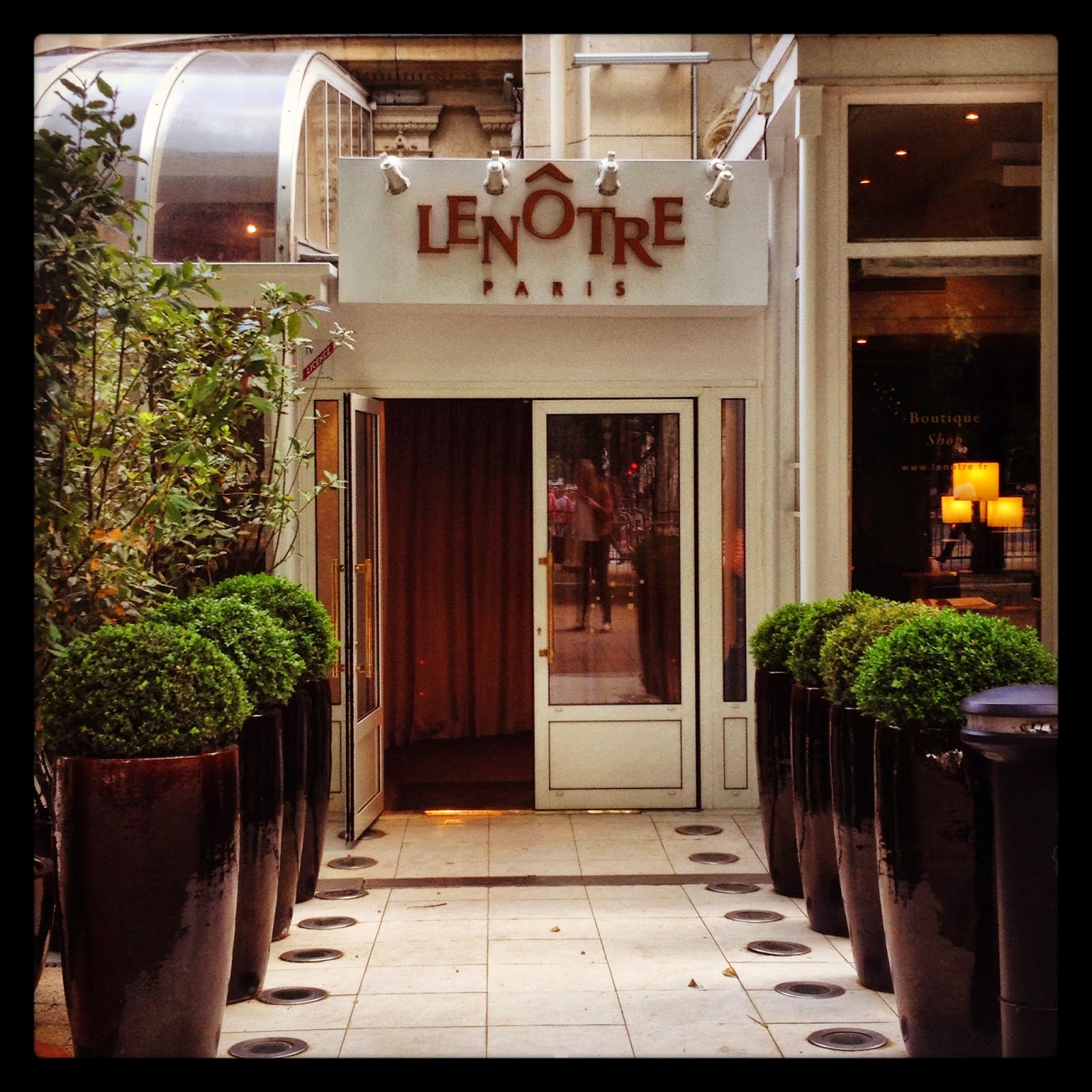
Saturday morning we found ourselves at Le Nôtre cooking school, home to some of the best macarons! We chose the "classics" class where we would learn to make chocolate, cafe and vanilla. The class was taught entirely in French! I can now honestly say that my French language immersion has worked as I got through the class with almost no problem!
Le Nôtre Ecole de Cuisine

Our instructor, Chef Legras, walked us through the first batch of macarons, vanilla, and took the time to explain why specific ingredients were used and the difference between the different types of sugar. He also explained why the order of ingredients was important, which I've been known to ignore once or twice in my baking past...
Chef Lagras at the end of the class, assembling macarons

After the first batch was in the oven, he had us work on each of the steps so that we could fully understand what we were doing. Getting the perfect macaron size and shape was a lot harder than it looked! Each one had to match so they would all bake evenly and in order to make it easier to sandwich them later. However, that is a lot harder than it sounds, so they were not all equally sized.
Piping macarons

The hardest part was not forming a small peak on the top of each shell after we picked the pastry bag up. While the shells were cooling, we were able to make the three ganache fillings which were used to sandwich our macarons.
Macaron Steps

The class was three hours long but time passed quickly as we were always busy and the class was lighthearted and fun. At the end of the class we were give recipes for each of the three flavors and boxes filled with our homemade macarons. After trying them they were a bit crunchy, but the filling and the macaron flavor were spot on. I think they were a little overcooked as they were all different sizes making it impossible to bake them evenly. Shelley and I now understand the difficulty in making the perfect macaron! 

Sunday, May 4, 2014

Champagne is one of the elegant extras in life

Saturday, Shelley and I headed to Reims about 45 minutes by train from Paris and located in Champagne. Our first stop was Notre-Dame de Reims which was built between 1211 and 1516. Starting with Louis I all of the French Kings were crowned here except for Louis VI and Henri VI. The Gothic style Cathedral's size and grandeur were exceptional. Sadly, part of the outside was under construction, but they had a small replica inside to see the exterior detail we missed. During WWI the Cathedral was heavily bombed destroying the exterior, stained glass windows and statues. Through major donations, notably by John D. Rockefeller, the Cathedral was repaired. Through these restorations you can see a mix of the original stained glass windows and newer more modern ones from Artists such as Marc Chagall and Bridgette Simon.
Notre-Dame de Reims

We then headed to lunch which finished just in time for our Veuve Cliquot Champagne Tour. Veuve Cliquot was founded in 1772 by Phillippe Cliquot Muiron who's goal was to have his champagne cross all borders. Phillippe's son, François, married Barbe-Nicole Ponsardin Cliquot, but he tragically died a few short years later, leaving Barbe-Nicole a widow at 27. The family was unsure what to do with the business but Madame Cliquot decided she would take it over, becoming one of the first business women of modern times. During her tenure she changed the name of the brand to Veuve Cliquot Ponsardin or Veuve Cliquot as we know it, meaning "Widow" Cliquot. Madame Cliquot was instrumental in growing the business while ensuring that their ideas of innovation and quality stayed central to the business.
The main symbol of the brand is the anchor, the Christian Symbol for hope & rigor. When Veuve Cliquot started labels did not yet exist and the anchor was branded onto the bottom of the cork to differentiate between brands. The VCP on the anchor stands for Veuve Cliquot Ponsardin. The hexagonal shape surrounding the initials and anchor represents the comet of 1811 that is said to have predicted the excellent harvest that year. In the 1860s the house added a label its bottle and the "yellow" color was chosen. Over the years the yellow became darker as a way to distinguish the bottle in the dark cellars. Lastly, the muselet, the wire cage that fits over the cork, has the portrait of Madame Cliquot, in her 80s, as a testament to her hard work and dedication in growing the brand.
Veuve Cliquot Journal and one of the original labels

After the history of the house, we headed down into the crayéres, or the champagne caves, 25 meters underground. The Veuve Cliquot crayéres were built during the Middle Ages and have quite the history! Each shape of the crayere is different as they were excavated not for storage but for the chalk for building materials. Over 400 crayéres exist underground for Veuve Cliquot alone! After the Middle Ages, bandits, who didn't want to pay taxes on imported goods would attempt to cross the city borders underground. Then during the World Wars they were used as shelters, tunnels and mini cities. The writing on the walls still exists, such as numbers and even red crosses for the hospital! Today, the labyrinth of crayéres are perfect for champagne production. They are dark and cool, keeping the 10-11 degree Celsius temperature needed year-round for champagne production no matter the weather outside. The Chalk walls also act as a giant sponge absorbing the moisture and providing the necessary humidity.
In the crayéres

With our crayére tour completed we were able to enjoy a glass of Champagne. A bottle of the Veuve Cliquot Brut, takes up to 3 years to create, and definitely not that long to drink! Champagne consists of a blend of different wines in order to give it its complex blend. The Brut consists of a minimum of 50% but upwards of 60% Pinor Noir, 30-35% Chardonnay and up to 40% reserves. In order to keep the champagne consistent from year to year up to 40% of the Veuve Cliquot mixture is reserve wines from previous harvests.
Post Tour
* Title quote by Charles Dickens

Friday, May 2, 2014

Belleau Wood

After a weekend touring the D-Day beaches and the North of France with my parents, I came back to Paris and they went on to Champagne. However, I was able to take Friday off and jumped on an early morning train to Château-Thierry My parents met me at the station and we headed to the Château-Thierry American Monument and the Aisne-Marne American Cemetery located in Belleau Wood. 
Old home in Belleau

The Belleau area is very important to the US Marines, especially my brother's regiment, the 3/6, which fought there. The battle was significant because it stopped the German advance to Paris, only about an hour's drive away. More Marines were killed in action and wounded on the first day of the battle of Belleau Wood (1,087) than in all previous engagements combined. However, the battle not only proved the embodiment of the USMC through their determination and dedication but was also the catalyst for the Marine Corps we know today.

The Château-Thierry American Monument commemorates the soldiers who fought in the region during WWI. Located on a hill, it provides striking views of its surroundings. The Monument's inscriptions are in both French and English and they tell the story of the battles fought in the region. On the front of the memorial is the American Eagle and a large map that depicts the battles in the area. 
Château-Thierry American Monument

We then headed to the Aisne-Marne American Cemetery. This cemetery was smaller than Normandy but very moving. The Aisne-Marne cemetery is located on the foot of the hill where the Battle of Belleau was fought and those who are laid to rest died at the Battle of Belleau and the Battle of Chateau Thierry. That morning I was able to pick up roses so that we could lay them by some of the graves. 
The Cemetery & the Chapel's stained glass windows

A Memorial Chapel is located in the center of the cemetery with the name of all those who have not been found inscribed on the walls. Walking into the chapel and being surrounded by all of their names was very powerful.
Panoramic of the inside of the chapel
 

Located not far from the cemetery is the Devil Dog Fountain at Belleau. When the Marines took Belleau Wood from the Germans in June 1918, the Germans had begun to call them Teufelhunden or "Devil Dogs," a name that is still used today. When the Marines entered the deserted village they found the bull dog fountain with fresh water. The fountain helped solidify the devil dogs name and their mascot, a bull dog in a WWI helmet was born. Legend has that if a Marine drinks from the fountain he will gain 20 years to his life. We obviously bottled some water up for James to drink! 
With the Bull dog fountain

After our tour of Belleau and the surrounding area we headed back to Paris for the night. The rest of the weekend went quickly! We spent the rest of the day and all day Saturday walking around. Sadly, my parents didn't get to enjoy Spring time in Paris weather, as it poured, but a little rain never hurts, right?! My parents left Sunday morning after their last French breakfast of croissants and coffee. I really enjoyed our trip and loved having them here! See you both in a few short months on the other side of the pond!
Saturday night in Paris

Monday, April 28, 2014

Easter Sunday & Monday

After a full day of touring D-Day my parents and I took no time to recuperate. We had so many other things to see in the north of France! As we were staying in Bayeux, our first stop was the Bayeux tapestry, an embroidered cloth that depicts the events leading up to the Norman conquest of England. Eri and I studied it during our art history class freshman year, and it was so much more impressive than I thought it would be. While walking the 70m length I came to the realization that this tapestry could be an entire course, not just one week!

We then headed up to Saint-Malo, a walled-port city in Brittany, where Jacque Cartier, who is credited with discovering Canada, sailed from. The Old Town was originally built on a rocky island, giving the inhabitants control of both the sea and the trade route. This strategic position gave rise to pirates and in the 17 & 18th centuries piracy grew rampant as the King of France allowed the pirates to go after enemy ships in return for a percent of the profit. Saint-Malo was heavily bombed and destroyed during WWII but during the post war years it was painstakingly reconstructed to an exact replica of its pre-war construction.
On the walls of Saint-Malo

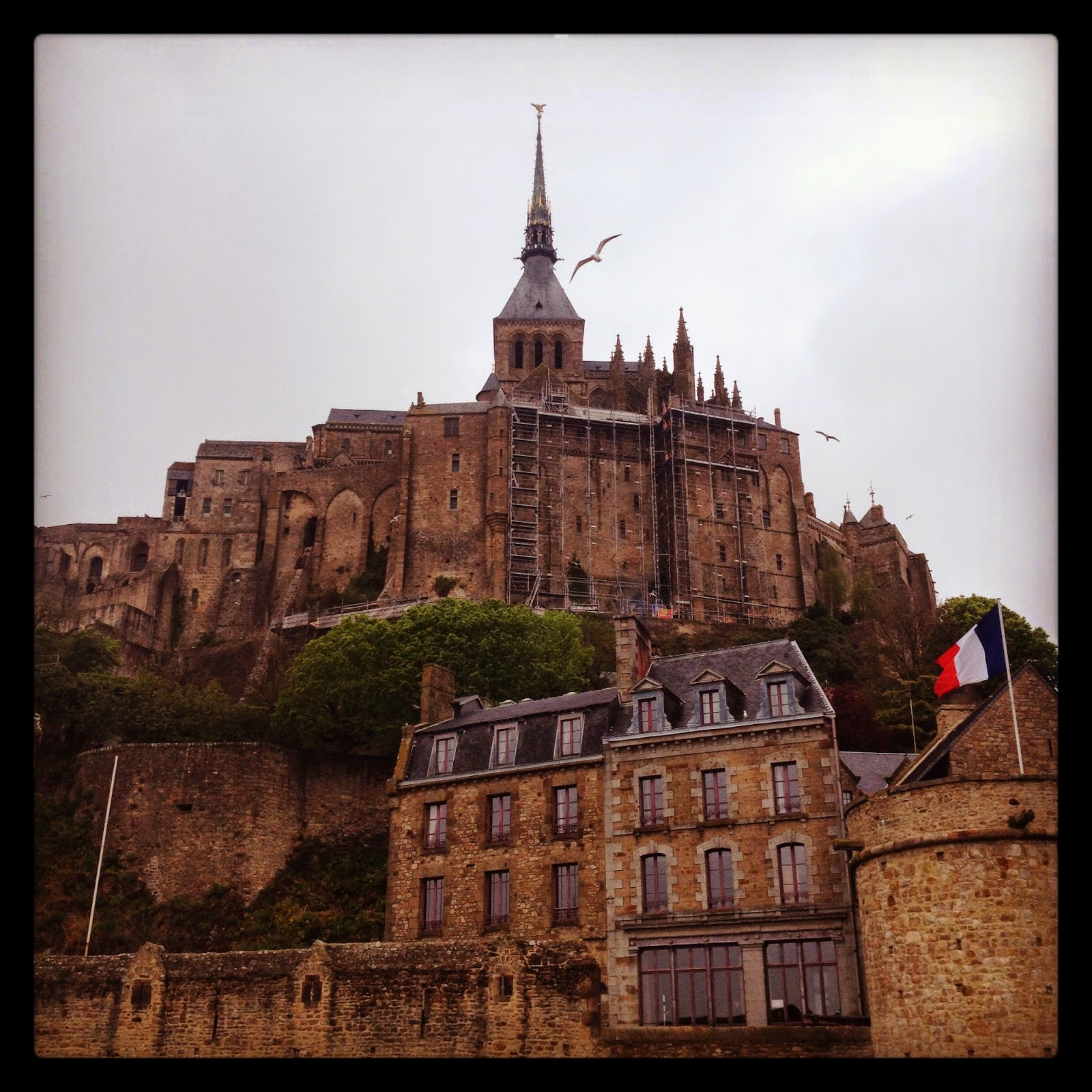
After lunch at Saint-Malo, we drove back into Normandy to visit Mont Saint-Michel, a UNESCO World Heritage Site. Mont Saint-Michel is a Gothic style Benedictine abbey dedicated to Saint Michael and a small village that was built around it. The entire abbey is located on a small island around 600 meters from the shore and its surrounding bay is home to the highest tides in Europe. The tides would help protect the abbey during times of invasion as the enemy would get caught during the tides and would be brought out to sea. Mont-Saint Michel was my favorite stop on Sunday and although cloudy and overcast, it was absolutely stunning and a huge architectural feat.
Saint-Michel from the shore looking up

I had Easter Monday off since it is a national holiday here, which allowed us to explore some more of Northern France. We started by driving up the coast and stopped at Honfleur, a beautiful little port city. The buildings lining the port were either painted in different colors or covered in slate shingles. While exploring the port area we stumbled upon a plaque in honor of Samuel de Champlain who sailed from Honfleur on his exhibitions to North America and Canada!
Honfleur Port

Our last stop before I headed home was Étretat, famous for its cliffs. Two cliffs with naturally made arches bookend the town. Falaise d'Aval, is the larger of the two and Falaise d'Amont. Falaise d'Aval (which kind of looks like an elephant's trunk!) was made famous by Monet who painted the cliff more than once. After walking on the rocky beach my parents and I climbed the steep stairs to get to the top of the Falaise d'Amont cliff. The top provided great views of the two Falaises and the sea. It was the perfect end to our weekend!
With Falaise d'Aval behind us
On top of a cliff with Falaise d'Amont

Wednesday, April 23, 2014

This is D-Day, This is the Day. The Invasion has begun!

Saturday my parents and I headed out with a guide to tour Normandy. I knew the day would be long and physically tiring but what I didn't expect was being so emotionally worn out.

Our guide, Geert, met us early Saturday and we headed to The American Cemetery of Normandy for the 9am opening. We were the first ones there and other than 1 or 2 other families by the end of our visit, we were the only ones. We were able to watch them raise the two American flags and really take in the cemetery. 9,387 soldiers are buried there and 307 of them are unidentified. The stark white crosses against the green grass seem to go on forever.
Normandy American Cemetery

When you enter the cemetery you pass the memorial. A large bronze statue symbolizing "American Youth Rising from the Waves" faces the cemetery. If you walk behind the memorial, you enter the Garden of the Missing, which lists the 1,157 men that have never been found. A large majority of the men were from the 66th division, who's boat was torpedoed on Christmas eve. A few of the names have small rosettes engraved next to them, symbolizing that they have since been found.
The American Cemetery, the reflective pool
an unknown soldier and the memorial

The weather at the cemetery was perfect, it was clear skies, sunny and peaceful. Geert brought us to the grave of Theodore Mister, who was killed on June 13 and who's path we would be tracing.

We then headed to Omaha Beach, which was the deadliest assault of D-Day, with around a 90% casualty rate in the first hour. The men left England for Omaha on July 4th and were dropped 10 miles off shore to take the landing boats in the rest of the way. The soldiers had to land at low tide and farther out from the shore then expected. They had to wade through the water to the beach and sand dunes hidden below the water were unanticipated and deadly. If a soldier stepped off the sand dune he would drown due to the heavy equipment. Once the men made it to the shore they had to sprint across the beach for cover, passing a wide open area, where many were shot down. Many of the men listed on the wall of the Garden of the Missing are presumed to have been washed out to sea.
On Omaha Beach

From there we headed inland tracing Mister's steps. We passed the Church of Trevieres located in the first town that many soldier's saw as they went inland. The 377th Infantry division's mission was to take back Trevieres. Upon entering they saw the church was badly bombed needed repair. They started a collection to help repair it and after the war they sent the collected money back, which would help replace the stained-glass windows. To thank the men, the town dedicated a special stained glass window on the altar in their honor.
Bottom of the stained glass window

Before lunch we went to the battle field where Theodore Mister was killed and learned his story. The Germans and Americans were fighting over a small yet strategic area. The Americans had to cross a valley with no shelter and forge up a hill directly into enemy fire. The Americans got caught in the valley and it seemed as though they would have to retreat. Mister, only a scout, ran across the valley and charged up the hill. While on the hill he turned and yelled, "Come on, follow me!" and was shot and killed. It was his bravery that gave his fellow soldiers a second wind and they were able to overcome and win the battle.
On Utah Beach

After lunch, we headed to Utah Beach, the western most beach of the 5 landing areas which had a much higher success rate than Omaha. Before the invasion, units of the 82nd and 101st airborne divisions were airdropped inland and suffered many casualties. However, they succeeded in isolating the soldiers landing on the beach from the Germans. One of the parachuters, John Steele, got stuck on a Sainte-Mère-Église steeple while landing and was taken prisoner. He escaped three days later and lived to tell the tale!
John Steele replica on Sainte-Mère-Église, a statue to remember the arrival of the airborne units & a memorial plaque

Our last stop was Pointe du Hoc, a cliff located west of Omaha beach that provides great views of Omaha and Utah beaches. The Germans had set up a lookout point with cannons and trenches to patrol the coastline providing the possibility of large scale damage to the D-Day invasion. In an attempt to decrease the carnage of D-Day, Pointe du Hoc was heavily bombed in the days leading to the invasion and today massive shell craters still pepper the surface. Due to its steep drop off, the Germans believed it would be impossible to scale and prepared for an inland invasion, however, the Army attacked from the coast by scaling the cliffs and after a 2 day siege took Pointe du Hoc.
At the bottom of a shell crater

Touring Normandy was an experience that I will never forget. It was a very powerful day and I am truly grateful that I was able to see it.

*Title quote from The Diary of Anne Frank quoted from the BBC

Sunday, April 13, 2014

Jardin du Luxembourg

Well hello, it's been a while! Between French classes and work and weekend outings I haven't had a second to blog! It's been so nice these past few weekends that I have spent my weekends wandering around and wasting the days away in this beautiful city! One of my favorite places is Jardin du Luxembourg. It has been a staple in my running route, as I incorporate it in every run. Although the winter months don't allow for flowers, the paths were still beautiful and it was great for people watching. However, the park is now in spring mode with all the flowers in bloom.
Pretty Park Flowers

In 1610 Queen Marie de Medici purchased the land to build a garden and palace for a new residence after the death of her husband. Her new residence, the Palais du Luxembourg and its surrounding gardens were modeled after the Pitti Palace and the Boboli Gardens in Florence, where she spent her childhood. She commissioned the architect, Salomon de Brosse, to design the Palace and it was completed 16 years later. Although the two have some decorative similarities de Brosse did not replicate the Pitti Palace exactly as the palace plan is French. This mix of the two styles creates an architectural transition piece between the Renaissance and classical period. The gardens, which were inspired by the Boboli gardens in Florence were quite small, only 8 hectares, due to the Carthusians Monastery located nearby. However, over time the garden was expanded to its current size of 55.5 acres, making it the second largest park in Paris
Palais du Luxembourg peaking out behind flowers in bloom

In front of the Palace is the octagonal Grand Bassin pond. Jardin du Luxembourg is a very popular place for people to come and relax, with many chairs and benches available for reading, enjoying the sun and picnicking. One of the more popular places is the pond. Here the kids are able to rent toy wooden boats to sail as parents nearby. Anywhere around the pond is great as you either have a view of the Palace or the vast gardens that surround it. Here it is if you are in a little green oasis.
Boats sailing on the pond

Wandering through the park, you'll pass a plethora of statues. I never thought much of it until I found out there are 106 statues scattered throughout as well as the Medici Fountain! Queen Marie de Medici originally had a grotto designed for the garden. Many years and slight alterations later, it was moved and changed into a fountain. Today, a new facade and marble and bronze statue representing a Greek myth are at the forefront. Acis & Galatea lie under a rock on top of which stands Polyphemus who is preparing to throw a stone at his rival.
Medici Fountain

Jardin du Luxembourg is my favorite garden. I love running there on weekend mornings or just going to enjoy the day. As the weather gets nicer and the gardens fill in more, I am looking forward to spending a lot more time there enjoying Paris in the Spring time!